
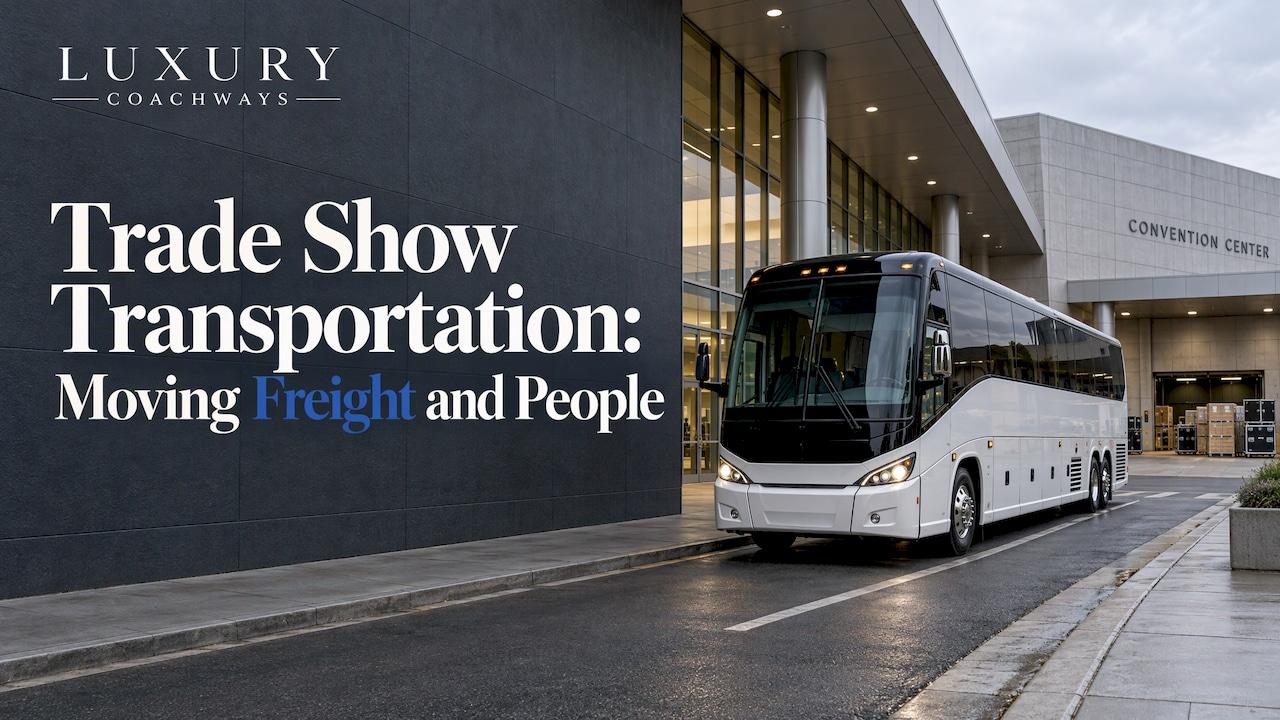
Trade show transportation is two jobs that share one calendar. The first is freight: getting booth materials to the venue dock and back. The second is people: getting staff, executives, clients and attendees between airports, hotels and the convention center on time. Freight follows the show contractor's rules. People movement is yours to design, and a well-planned charter shuttle is the simplest way to do it for a group.
This guide covers both sides, with the most space on moving people, because that is where event teams have the most control and the most to gain.
TL;DR
- Trade show transportation means two things: exhibit freight (shipping, drayage, return) and ground transportation for staff and attendees. Plan them separately.
- Freight has fixed rules: advance warehouse or direct-to-show delivery, target times, marshaling yard check-in and outbound paperwork. Missing them can add charges.
- For people, a dedicated charter bus, minibus or Sprinter van loop between hotels, airport and venue replaces dozens of separate rides with one schedule.
- Lock your headcount, arrival times and pickup points early, then confirm everything again in the final week.
- We run charter, coach, minibus and Sprinter service nationwide with 24/7 concierge support, and quotes are free and instant.
Table of Contents
- What trade show transportation actually includes
- How exhibit freight works at the convention center
- Planning ground transportation for staff and attendees
- A planning timeline that works
- What to tell your transportation provider
- Budgeting without surprises
- Our perspective on trade show transportation
- Book your show transportation with us
- Show-week tips from the field
- FAQ
- Sources
What trade show transportation actually includes
Search results for this topic are dominated by freight companies, and for good reason. Freight is the part exhibitors cannot skip. But the term covers more than trucks.
Exhibit freight. One major show services provider describes its transportation service as moving materials from the exhibitor's location to the event venue, while material handling takes over from the loading dock to the booth. Freight is the trip to and from the show. Drayage, also called material handling, is the show contractor's service for receiving freight and moving it between the loading area and the booth. They are separate services with separate charges.
Event logistics around the freight. In the wider event sense, transportation and logistics can cover planning, coordination, movement, storage and timing of exhibit and event assets, from pre-show shipping and advance warehousing through on-site delivery and outbound shipping.
People movement. This is the side that rarely appears in freight guides: airport transfers, hotel-to-venue shuttles, executive travel, off-site dinners and client entertainment. It decides whether your sales team arrives rested and on time, and whether your clients reach your booth or your evening reception.
| Area | What moves | Who controls it | Main risk |
|---|---|---|---|
| Booth freight | Exhibit, crates, collateral | Show contractor rules plus your carrier | Missed target time, extra handling fees |
| Material handling (drayage) | Freight from dock to booth | Official show service provider | Charges for late or off-hours delivery |
| Staff and attendee transport | People and light luggage | You, the organizer or the exhibitor | Late pickups, split groups, no-shows |
| Hospitality transport | Clients, VIPs, dinner groups | You | Poor first impression, delays |
How exhibit freight works at the convention center
Even if you are reading this for the people side, you should understand the freight calendar, because it sets the rhythm of your whole show week.
Advance warehouse or direct to show
Exhibitors generally ship one of two ways. Exhibit freight can go to an advance warehouse before the event, where it is received, stored and delivered to the booth during scheduled move-in. That reduces the risk of late deliveries and helps avoid congestion at peak move-in hours. Or it can go directly to the show site during designated move-in periods. Published exhibitor manuals spell out cutoff dates for each option, so the manual for your specific show is the document to trust.
Targets, marshaling and paperwork
A targeted show assigns each booth a specific delivery date and time based on its location on the show floor. If your shipment misses its window, additional charges may apply.
Convention centers also use a marshaling yard where drivers check in before reaching the docks. A late truck can cost the venue heavy extra labor fees while workers wait, and freight collected late after the show may be moved off the dock to a nearby warehouse at the exhibitor's expense.
Exhibitor manuals also commonly require paperwork. One 2026 manual states that certified weight tickets are required on all shipments, and a bill of lading must list the number of pieces and their description.
A freight checklist
Guidance from a major show services provider suggests you give the carrier the event name, booth number, marshaling location and move-in and move-out information. It also advises packaging, labeling and insuring the shipment properly, requesting a certified weight, and asking the carrier about waiting-time fees and fuel surcharges.
Move-out and return shipping
At show close, the process runs in a set order: the contractor returns your empty crates to the booth, you complete an outbound bill of lading and hand it to the service desk, your carrier checks in, and the driver is called to the dock to load. Clear paperwork and carrier communication help freight depart efficiently during move-out.

Planning ground transportation for staff and attendees
Freight is moved by specialists. People are moved by you, and the same discipline applies: a schedule, a headcount and a backup plan.
Start with the three legs of the trip
Most trade show travel breaks into three legs:
- Airport to hotel. Arrivals cluster around the day before the show opens, with flights landing at different times.
- Hotel to venue and back. A steady loop at show open and close, plus evening runs.
- Off-site movement. Client dinners, receptions, factory or site visits, and the trip back to the airport.
Each leg has a different demand pattern. Airport transfers are staggered. Hotel shuttles are predictable and peak-heavy. Off-site trips are one-offs for specific groups.
Airport transfers
Event planning guidance suggests you estimate distance and travel time, check whether the venue offers complimentary transportation, and tell the venue your expected attendee numbers and arrival and departure dates. It also recommends giving attendees alternatives such as cabs, public transportation, rental cars and onsite parking.
For a team of 12 or more landing within a few hours of each other, a single scheduled pickup beats individual rideshares: one meeting point, one vehicle, one arrival at the hotel. For executives and small groups, a Sprinter van keeps the group together without the overhead of a full coach. Our airport charter shuttles are built for this.
Hotel shuttles
For hotel shuttles, the same guidance says to set the budget and schedule, choose which hotels to serve, and consider excluding hotels within 0.25 to 0.5 miles of walking distance. That last point saves real money: serve the hotels that need it, and let the rest walk.
A few practical rules we would apply:
- Run a loop, not a taxi service. A fixed circuit with a published timetable beats on-demand dispatch for a show with hundreds of attendees.
- Add frequency at the edges. The first hour before doors open and the hour after close are when queues form.
- Put signage at every stop. Branded boards at the hotel curb and the venue loading zone cut confusion.
- Assign one on-site coordinator. One person with the dispatcher's number should own the schedule.
Choosing the right vehicle
Match the vehicle to the group, not the other way around.
| Group size | Typical fit | Where to look |
|---|---|---|
| Small executive group | Sprinter van | Sprinter van rental |
| Mid-size team | Minibus | Minibus rental |
| Large staff or attendee group | Full-size motor coach | Coach bus rental |
| Hotel loop with high volume | Multiple coaches on a timed circuit | Charter bus rental |
| VIP or client entertainment | Limousine or party bus | Limousine rental |
For larger groups, our fleet pages for 45 passenger and 56 passenger coaches show what is available.
A planning timeline that works
One logistics provider's timeline for freight is a useful frame for everything else. It recommends reviewing the exhibitor manual and venue requirements 8 to 12 or more weeks before the show, reserving capacity 6 to 8 weeks out, finalizing the schedule 4 to 6 weeks out, confirming shipment details 2 to 4 weeks out and reconfirming everything in the final week.
We suggest mapping people transportation onto the same calendar:
- 8 to 12 weeks out: Gather the venue's rules, hotel block locations and expected attendee counts. Request a quote for the shuttle plan.
- 6 to 8 weeks out: Reserve vehicles. Large shows put pressure on coach availability in the host city, so early reservation protects your options.
- 4 to 6 weeks out: Finalize the timetable, stops and pickup points.
- 2 to 4 weeks out: Send passenger lists, flight details and meeting points to the provider.
- Final week: Reconfirm times, share the dispatcher's number with your on-site coordinator and brief your team.
These are planning habits, not rules. Your show's own exhibitor manual and venue guidelines always come first.
What to tell your transportation provider
A charter quote is only as good as the information behind it. Event ground transportation planning guidance lists what to collect before you confirm a schedule: passenger names and working contact numbers, exact collection and destination points, required arrival times, flight or rail details, passenger, luggage and equipment quantities, vehicle and chauffeur accreditation requirements, access instructions, primary and alternative meeting points, the authorized decision-maker, communication expectations and contingency arrangements.
In practice, here is the short version we ask for:
- Event name, venue and city, with show dates and daily hours.
- Pickup and drop-off points, including the venue's designated loading zone.
- Headcount per run, plus luggage and any display equipment riding with passengers.
- Arrival and departure flight times for airport runs.
- The name and mobile number of the person who can approve changes.
- A fallback plan: what happens if a flight is delayed or a session runs late.
Bring luggage and equipment numbers into the conversation early. A team carrying roll-up banners, product samples or marketing cases needs a different vehicle than the same team with carry-ons.
Budgeting without surprises
We do not publish fixed rates for charter service, because the price depends on the vehicle, the hours, the city and the schedule. The quote is free and instant, so you can compare options for your show date.
On the freight side, the charges to understand are the ones tied to timing. As noted above, missed targets and late arrivals can trigger additional charges, and the same is true of any rule on receiving dates, marshaling and outbound deadlines, since missing them can create extra handling, re-delivery, storage or overtime charges.
For people transportation, the costs that move the number are:
- Hours of service. A shuttle loop that runs from 7 a.m. to 7 p.m. costs differently from a two-peak schedule.
- Number of vehicles. Two coaches on a short circuit can outperform four vehicles on a long one.
- Deadhead and wait time. Vehicles standing by for a late session or a flight delay are part of the schedule.
- Vehicle type. A Sprinter, minibus and full coach all have different fit and cost profiles.
The simplest way to control spend is to cut the number of separate rides. One scheduled coach for 40 people replaces a long queue of individual rides and keeps your team together for the pre-show huddle.
Our perspective on trade show transportation
We see the same pattern every show season: teams plan the freight to the last pallet and leave the people for the week before. The booth ships on a schedule, and then the staff who run it arrive in ones and twos, miss the first morning briefing and spend their first hour sorting out rides.
Our view is that people deserve the same discipline as freight. A fixed timetable, one meeting point, a named coordinator and a dispatcher reachable around the clock turn a chaotic arrival day into a routine one. That is why we pair every charter with 24/7 concierge support, and why our chauffeurs are professional and background-checked.
Comfort matters more at a trade show than at most events. Your team will be on its feet for hours, then talking to prospects. A motor coach with leather interiors, high-speed Wi-Fi and, on our coaches, restrooms lets them recover, answer email and arrive ready. Our vehicles are fully insured and meticulously maintained, so the ride is one less thing on your list.
Our advice: choose the vehicle by group, not by habit. Executives travel well in a Sprinter van. A sales team fits a minibus. A full show staff or a hotel loop needs a coach. We cover cities nationwide, so the same standard follows you from one show to the next.
the author
Book your show transportation with us
If you are moving a team, a client group or a set of attendees to and from a convention center, our convention and event transportation service is built around exactly that: scheduled loops, airport transfers and off-site trips, with professional chauffeurs and 24/7 concierge support. Instant quotes are free, and our vehicles are fully insured.

Browse our full list of charter bus services or check where we operate to match your show city. For executives and VIP clients, see our executive business travel service.
Show-week tips from the field
These are the habits that keep a show week calm, drawn from how we run group transportation.
Brief your team before they land. Send a one-page sheet with the pickup point, timetable, dispatcher's number and hotel details. Teams that know where the shuttle stops do not need to call anyone.
Keep the loop visible. Post the timetable in the lobby, in the show app if there is one, and in your event email. Attendees who find the schedule themselves do not queue at the front desk.
Respect the venue's rules. Convention centers manage vehicle access tightly, from loading zones to check-in procedures. Ask the venue where shuttles may stop, and share that with your provider before the day. The same applies to chauffeur and vehicle accreditation, which the event planning guidance above lists as something to confirm in advance.
Plan for the late finish. Sessions overrun and evening receptions drag on. Build a buffer into the last run of the day, and give your coordinator authority to extend it.
Think about the exits. The last day is when freight, luggage and people leave at once. Stagger airport departures against show close and keep the outbound freight paperwork out of the hands of the same person who is supervising the shuttle.
Use corporate hospitality wisely. An evening transfer for clients to a dinner or reception is a small cost compared with the value of one-on-one time. Our corporate event bus rental works well for these off-site trips, and a larger gathering can combine them with a concert and event shuttle.
FAQ
What is trade show transportation?
It covers everything that moves for a show. That means exhibit freight to and from the venue, material handling between the dock and the booth, and ground transportation for the people who staff and attend. Freight follows the show contractor's rules, and people transportation is arranged by the organizer or exhibitor.
How far ahead should I book a charter bus for a trade show?
As soon as you know your dates and rough headcount. A common freight planning timeline reserves capacity 6 to 8 weeks before the show, and we suggest following the same rhythm for vehicles. Large shows can stretch local availability, so earlier is safer.
Do I need a shuttle if hotels are near the convention center?
Not for every hotel. Planning guidance suggests considering excluding hotels within 0.25 to 0.5 miles walking distance from the shuttle route. Focus the service on hotels farther away and on airport arrivals, where a group pickup saves the most time.
What information does a charter company need for a quote?
Event dates and city, pickup and drop-off points, headcount, luggage or equipment, flight times for airport runs and the name of your decision-maker. Our quotes are free and instant, and our concierge team can help fill in the rest.
Can the same provider handle my booth freight?
Booth freight runs through carriers and the show's official material handling provider. We focus on moving your people, and we coordinate our schedule around your freight calendar so your team is at the venue when the booth is ready.
Sources
- Freeman Transportation
- Trade Show Freight & Logistics
- Transportation & Logistics, Fern Expo
- Digital Dealer 2026 Exhibitor Service Manual
- Trade Show Logistics Guide for Shipping, Freight & Handling
- FAQs, Expert Show Logistics
- Trade Show Freight Challenges at Major Convention Centers
- Material Handling: Understanding the Process of Freight
- Transportation for Your Event
- Planning Seamless Trade Show Event Transportation
- Major-Event Ground Transportation Planning Guide